The Story
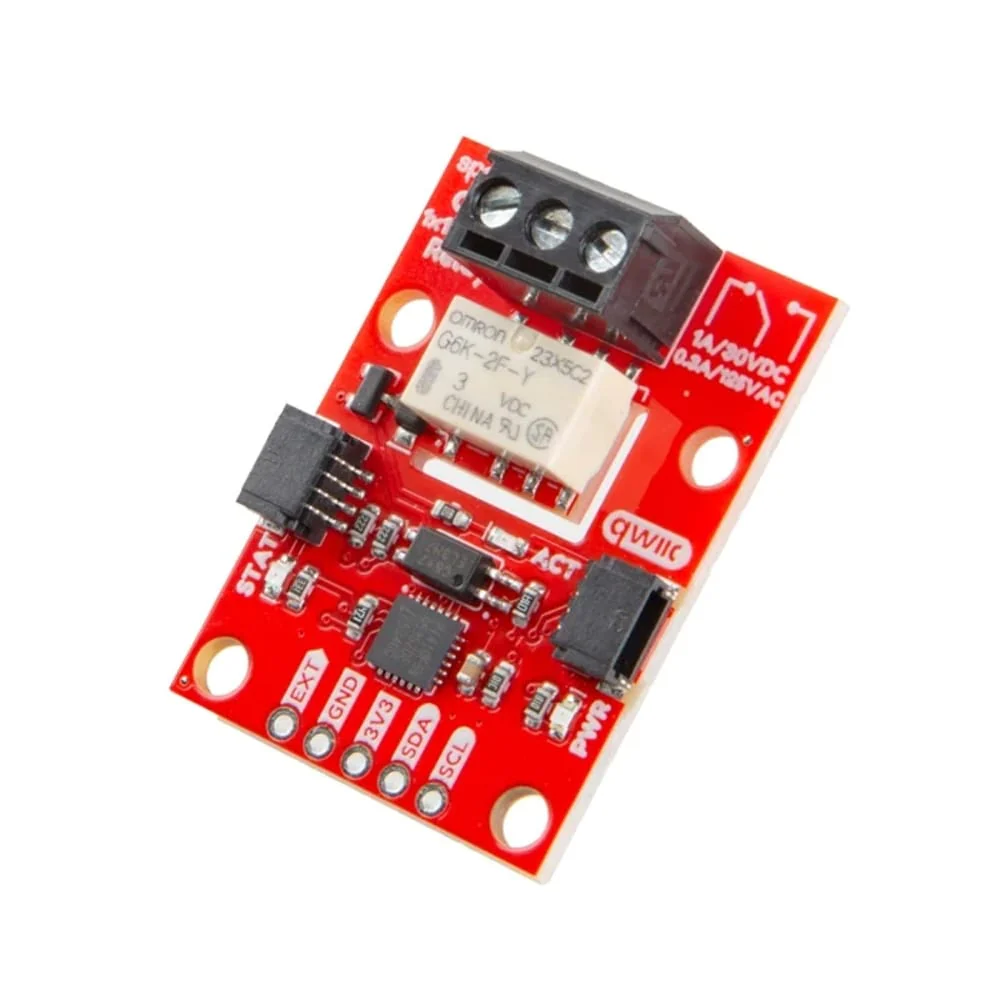
The Qwiic DPDT Relay lets you switch two circuits via I2C or external input, with simple wiring and Qwiic connectors for easy integration.
Easily control high-power devices directly from your microcontroller via I2C with the SparkFun Qwiic Relay. Built around the Omron G6K-2F-Y DC3 dual-pole/dual-throw (DPDT) relay, this board allows you to safely switch loads up to 1A at 30VDC or 0.3A at 125VAC (at 40°C). This relay is perfect if you're controlling heavy-duty motors or managing other high-power devices, bridging the gap between low-voltage logic and high-power applications.
Flexible Control Options
We designed this board to adapt to your specific project needs, offering multiple ways to trigger the relay:
- I2C Drive: Controlled via the on-board TCA9555 GPIO expander, requiring a remarkably low drive current of just 5.8mA at 3.3V.
- External Drive: This relay can also be triggered by an external input, such as a physical switch or a standard I/O signal (up to 50mA), giving you hardware-level control.
- Solderless Qwiic Integration: Two on-board Qwiic connectors let you add the relay to your I2C daisy chain without ever touching a soldering iron.
Transitioning from a Single Relay
If you are upgrading from our original Qwiic Single Relay, this DPDT version introduces a few key architectural differences that have been tailored for precision control:
- Dual-Circuit Control: While the original relay used a single-pole (SPDT) design, this DPDT board can switch two completely independent circuits simultaneously with a single command.
- Signal Optimized: The original relay was primarily built for heavy, high-voltage AC loads up to 5.5A at 240VAC. This new DPDT version is specifically engineered for lower-power signal-level switching up to 1A at 30VDC.
- Advanced Drive: Don't want to use I2C? This board allows external devices to drive the relay control directly.
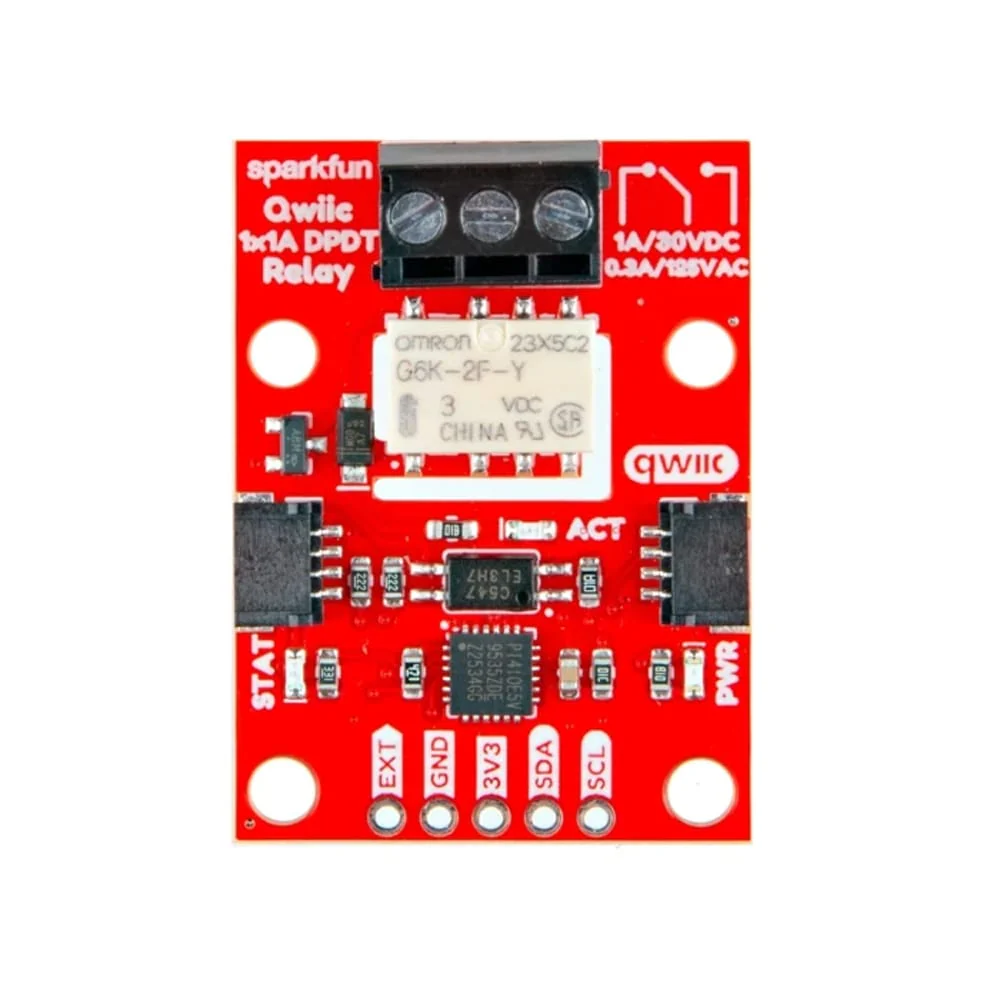
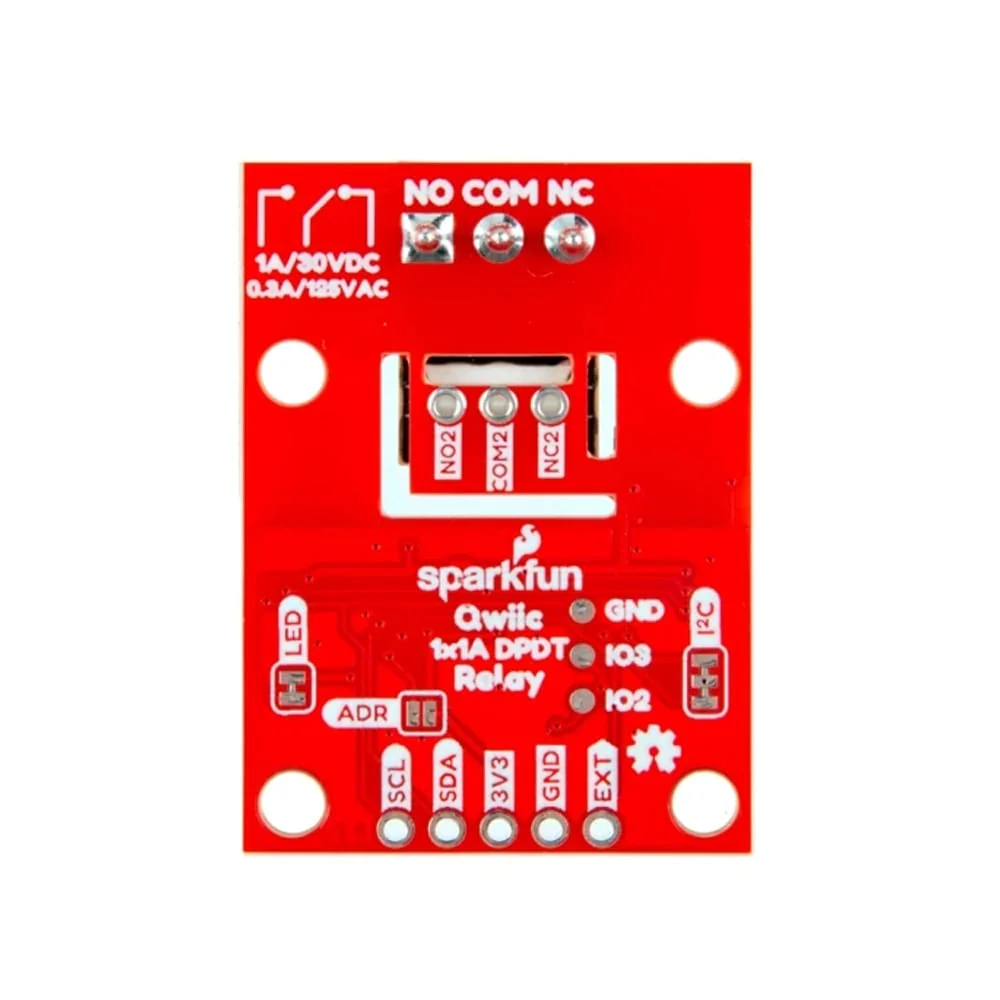
Wiring your high-power components is as straightforward as it gets with the Qwiic Relay. We included a 3-pin screw terminal for a quick, completely solderless connection to the relay's primary pole (COM Pole). Meanwhile, the secondary pole (COM2 Pole) is broken out to standard 0.1-inch-spaced plated-through holes (PTH), giving you the flexibility to solder wires directly or use a breadboard for prototyping.
Features
- G6K-2F-Y DC3 DPDT Relay
- Load Limits: 1A/30VDC and 0.3A/125VAC
- I2C Drive Current: 5.8mA
- External Drive Current: 50mA
- Relay Connections
- COM Pole: 3-Pin Screw Terminal
- COM2 Pole: 0.1"-spaced PTH
- TCA9555RTWR I2C GPIO Expander
- I2C Address: 0x20 (Default), 0x21 (Alternate)
- 2x Qwiic Connectors
- LEDs
- Red power (PWR) LED
- Green status (STAT) LED
- Green relay activity (ACT) LED
Resources
- Schematic
- KiCad Files
- Board Dimensions
- Datasheets:
- G6K-2F-Y DC3 DPDT Relay
- TCA9555 GPIO Expander
- Hookup Guide
- SparkFun I2C Expander Arduino Library
- GitHub Repository
Details & Craftsmanship
Every detail has been carefully considered to bring you the perfect product.
Details & Craftsmanship
Every detail has been carefully considered to bring you the perfect product.
Details & Craftsmanship
Every detail has been carefully considered to bring you the perfect product.
Description
The Qwiic DPDT Relay lets you switch two circuits via I2C or external input, with simple wiring and Qwiic connectors for easy integration.
Easily control high-power devices directly from your microcontroller via I2C with the SparkFun Qwiic Relay. Built around the Omron G6K-2F-Y DC3 dual-pole/dual-throw (DPDT) relay, this board allows you to safely switch loads up to 1A at 30VDC or 0.3A at 125VAC (at 40°C). This relay is perfect if you're controlling heavy-duty motors or managing other high-power devices, bridging the gap between low-voltage logic and high-power applications.
Flexible Control Options
We designed this board to adapt to your specific project needs, offering multiple ways to trigger the relay:
- I2C Drive: Controlled via the on-board TCA9555 GPIO expander, requiring a remarkably low drive current of just 5.8mA at 3.3V.
- External Drive: This relay can also be triggered by an external input, such as a physical switch or a standard I/O signal (up to 50mA), giving you hardware-level control.
- Solderless Qwiic Integration: Two on-board Qwiic connectors let you add the relay to your I2C daisy chain without ever touching a soldering iron.
Transitioning from a Single Relay
If you are upgrading from our original Qwiic Single Relay, this DPDT version introduces a few key architectural differences that have been tailored for precision control:
- Dual-Circuit Control: While the original relay used a single-pole (SPDT) design, this DPDT board can switch two completely independent circuits simultaneously with a single command.
- Signal Optimized: The original relay was primarily built for heavy, high-voltage AC loads up to 5.5A at 240VAC. This new DPDT version is specifically engineered for lower-power signal-level switching up to 1A at 30VDC.
- Advanced Drive: Don't want to use I2C? This board allows external devices to drive the relay control directly.
Wiring your high-power components is as straightforward as it gets with the Qwiic Relay. We included a 3-pin screw terminal for a quick, completely solderless connection to the relay's primary pole (COM Pole). Meanwhile, the secondary pole (COM2 Pole) is broken out to standard 0.1-inch-spaced plated-through holes (PTH), giving you the flexibility to solder wires directly or use a breadboard for prototyping.
Features
- G6K-2F-Y DC3 DPDT Relay
- Load Limits: 1A/30VDC and 0.3A/125VAC
- I2C Drive Current: 5.8mA
- External Drive Current: 50mA
- Relay Connections
- COM Pole: 3-Pin Screw Terminal
- COM2 Pole: 0.1"-spaced PTH
- TCA9555RTWR I2C GPIO Expander
- I2C Address: 0x20 (Default), 0x21 (Alternate)
- 2x Qwiic Connectors
- LEDs
- Red power (PWR) LED
- Green status (STAT) LED
- Green relay activity (ACT) LED
Resources
- Schematic
- KiCad Files
- Board Dimensions
- Datasheets:
- G6K-2F-Y DC3 DPDT Relay
- TCA9555 GPIO Expander
- Hookup Guide
- SparkFun I2C Expander Arduino Library
- GitHub Repository